Monday, March 5, 2018

What can you do with a Rebozo?

Image result for what can you do with rebozo

Tafolla, C., & Córdova, A. (2008). What can you do with a Rebozo?. Berkeley, CA: Tricycle Press. ISBN: 1582462208
Plot Summary
What Can You Do With a Rebozo? is a warm light hearted adventure of a girl sharing her Mexican culture and the importance of her shawl. She uses her shawl for everything, from carrying her baby brother to making a costume out of it!

CRITICAL ANALYSIS
Tafolla allows readers to learn about an important cultural marker in the Mexican culture which is a Rebozo! Through the illustrations, readers will learn that a Rebozo is a long wide cloth that can be used for many things from a baby carrier to a costume.  

The author’s  interlingual use of Spanish naturally exposes readers to the Spanish language.
Young readers will be attracted to another cultural marker in this book which is  the vibrant beautiful illustrations. Amy Cordova brings the Spanish culture to life with the bright traditional colors like yellow, red, blue, and green in the illustrations. In addition, the visuals gives readers an idea of certain traditions and customs they have from celebrating their birthday (hitting a piñata),  The illustrations also shares with readers certain Spanish customs such as birthday piñatas, dancing La Bamba, and family time. At the end of the book, readers will  value the significance of the little things in the Mexican culture.

REVIEW EXCERPTS
 Horn Book Guide (Fall 2009)
"Bright, colorful acrylic illustrations with flowing lines decorate this celebration of a rebozo (Mexican shawl). Lyrical rhyming text is narrated by a girl describing members of her extended family. This bilingual edition is an effective way to introduce a piece of cultural heritage. An author's note tells about the rebozo, as well as asking readers what they might do with one."
School Library Journal                                                                                                                
"Pictures of family life frame simply rhythmic text, and rich bands of jewel-toned acrylics highlight and demonstrate both the versatility of the shawl and the warm family relationships."

Connection
What can you do with? I don’t know, but you can check out another fun read by Tafolla!


What Can you do with a Paleta? Tafolla, C., & Morales, M. (2009). What can you do with a Paleta?. Berkeley, Calif: Tricycle Press. ISBN: 1582462895


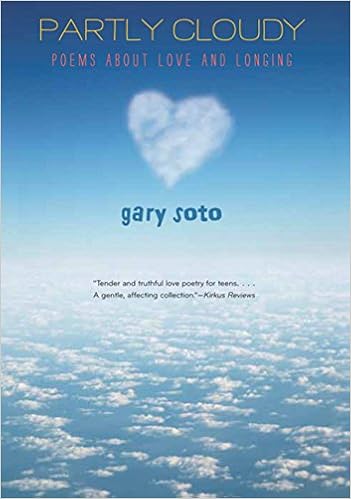
PARTLY CLOUDY, Poems of Love and Longing

Image result for PARTLY CLOUDY, Poems of Love and Longing


BIBLIOGRAPHY

Soto, Gary. PARTLY CLOUDY, Poems of Love and Longing. Boston: Houghton Mifflin Harcourt. 2009. ISBN 978054757737.


PLOT SUMMARY
Partly Cloudy, Poems of Love and Longing by Gary Soto is the perfect read for teens. The novel is about the chaotic love lives of teenagers. Gary Soto divided this novel into two parts. The first part is about teenage girls’ perspective of love and the second part is about teenage boys’ perspective. From the downward dips of a breakup to the upward twist of the first kiss! Readers will be able to experience what it feels like to be on a poetic love rollercoaster!


CRITICAL ANALYSIS
Partly Cloudy will connect with teens all over the world! This is not just another boring poetry read. Once readers open this book, they won’t be able to close it! Gary Soto does a great job revealing love in both genders’ perspectives. Many readers will find themselves laughing, smiling, and crying while reading this book.

Although Gary Soto is an award winning Hispanic author, there were not many cultural makers that stood out in this book. The description of some of the teens hairstyles reveals a portion of their culture. However, as I kept digging and rereading I realized that cultural markers does not have to involve just race and ethnicity of the author. I found that Soto highlighted the love experience for both teen girls and boys in his book. Gender plays a major role in our culture today. Gary Soto creatively integrates both perspectives of love in this short poetic read. In the first part of the book titled, “A Girl’s Tears, Her Songs” readers will be able to understand that females express more emotion than males when it comes to love. In contrast, the second part of this book “ A Boy’s Body, his words”, reveals to readers that males are more physical when it comes to love.


REVIEW EXCERPTSBooklist (February 15, 2009 (Vol. 105, No. 12))
“Young teens will enjoy the “love sick” puns and the metaphors, lyrical and sad, that show there is poetry in the way they speak.”

Horn Book Guide starred (July, 2009)
“...the free-verse poems all ring true: appropriately corny, rich with image, accessible and believable. The simple, open design encourages browsing, and readers flipping through are bound to find the right words when they need them.”


Connections

More culturally authentic books by Gary Soto!

Soto, G. (2006). Buried onions. Orlando, Fla: Harcourt. ISBN: 0152062653
Soto, G. (2006). Petty crimes. Orlando: Harcourt, Inc.ISBN: 0152054375
Soto, G. (2012). Facts of life: Selected stories. ISBN: 0547577346

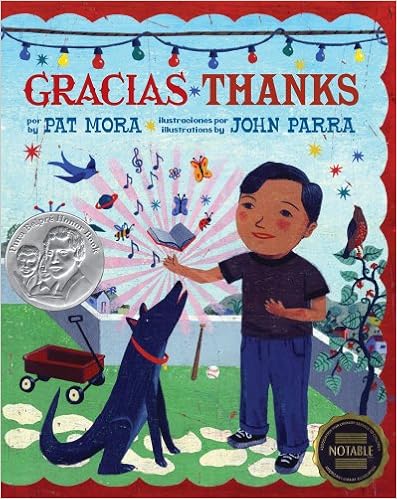
Gracias, Thanks


BIBLIOGRAPHY
Mora, P., Parra, J., & Domínguez, A. (2009). Gracias, Thanks. New York: Lee & Low Books. ISBN: 1600602584

PLOT SUMMARY
Gracias, Thanks is a book about a young boy very thankful for the simple things in his life. Throughout this text, the boy expresses his gratitude for the sun that wakes him in the morning, friendship, family, and so many more things!
CRITICAL ANALYSIS
This is a recommended read for all students that are bilingual or would like to learn the Spanish language. Pat Mora teaches English and Spanish readers to cherish the small things they have in life! Although the main character is Spanish, readers of all nationalities can connect with this book through the diverse illustrations. Pat Mora’s creatively integrates the Spanish language in this poetic read by writing Spanish on one side and the English translations on the other side.
In addition, many readers will explore many cultural markers in this picture book. John Para does an excellent job with sharing the elements of the Spanish culture with his beautiful illustrations. Students will be drawn to the bright Spanish hues (yellow, red, blue, orange, & green).   Students will also be able to notice that Hispanic people can comes in all different shades of color from dark brown to lighter skin tones.  
Students are able to see throughout the book how much the Spanish culture value their family and friends. While the main character is giving the thanks, the illustrations shows him spending time with  the people he cares about the most.  After reading this book, students of all different nationalities will learn the importance of being thankful of the simple things in life.
 REVIEW EXCERPTS
From School Library Journal

"This delightful bilingual book has universal appeal and would be a wonderful choice for library storytimes or classroom read-alouds as the giving thanks theme lends itself to holidays and social topics. The author endnote challenges readers to list the things for which they are thankful. A must buy for all libraries looking to add to their children Spanish collections."–Shannon Dye Gemberling, Peoria Public Library, AZ
From Booklist
“Parra’s vivid acrylic illustrations have the feel of folk-art woodcuts and whimsically portray the details of the boy’s world, from his kite and books to his tennis shoes and ice cream. Books of thanks can run toward clichés, but the originality and liveliness of language and art in this one will inspire children to consider their own blessings.”
Connections

Monday, February 19, 2018

Knock knock: My Dad's Dream For Me


See the source image
BIBLIOGRAPHY

Beaty, D., & Collier, B. (2013). Knock knock: My dad's dream for me.New York; Boston : Little, Brown and Company. ISBN 0316209171

PLOT SUMMARY

Knock Knock: My Dad’s Dream For Me is an award winning picture book that reveals the struggle a young boy faces when his father goes to jail. The young boy enjoys bonding with his father by playing the “Knock Knock” game until one morning when his father disappears. The young boy experiences a plethora of emotions including confusion, sadness, anger, and loneliness. He really misses his father’s presence in his life and decides to write him a letter in hopes he will return home while he is in school. Time passes and his father finally replies to the letter. His letter seeks to give the young boy advice ranging from how to become a man to how to treat his mother. At the conclusion of the letter, he assures his son that he will have a bright and beautiful future in spite of his absence.

CRITICAL ANALYSIS

Many young African American children will relate to this sensitive topic of losing a loved one. This book reveals the problematic yet authentic reality of the mass incarceration of African American males and the effect it has on the youth. In an author’s note in the back of the book Beaty explains to readers that this is indeed his own life story. He discusses the struggles at risk children of color face with losing their father figure from incarceration, divorce, and even death, which may lead to a lasting negative impact on their future.

Although losing a loved one can be very difficult, Beaty creatively explains to readers that you can still create a beautiful future through believing in yourself. Bryans Collier’s illustrations takes readers on a journey of the main character’s life showing how he grew up to defy the odds against him. The illustrations also allows readers to see how important family is in the African American culture. Young readers of color will be able to see themselves in the book through Collier’s realistic illustrations of the skin tone and hair texture of each character.

REVIEW EXCERPTS

Booklist (November 1, 2013 (Vol. 110, No. 5))

“In a rare topic for younger children, Beaty explores the theme of permanent separation from a parent (it could be prison, death, or abandonment). The desire for guidance encountering life’s experiences is told from a small child’s point of view with candor, as well as hope, as he ends quoting papa’s advice to “KNOCK KNOCK down the doors that I could not.”

Horn Book Guide starred (Spring 2014)

“Each morning, a little boy pretends to be asleep until his dad approaches. "Then I...jump into his arms." One day, his father fails to appear. The author's note explains that Beaty's own father was incarcerated; in the book, the absence is unexplained for a more universal story of loss. The text, powerful and spare, is well supported by Collier's watercolor and collage art.”


CONNECTIONS
More books about African American father figures!

Steptoe, J. (2001). In Daddy's arms I am tall. New York: Lee & Low. ISBN 1430110384

Johnson, A., & Mitchell, R. (2000). Daddy calls me man. New York: Orchard books. ISBN 0531071758

Tarpley, Natasha. (2009). Bippity Bop Barbershop. Bt Bound. ISBN 0316033820


Firebird


Image result for firebird by misty copeland
BIBLIOGRAPHY

Copeland, M., & Myers, C. (2014). Firebird: Ballerina Misty Copeland shows a young girl how to dance like the firebird. New York, NY : Penguin Group
  • ISBN: 0399166157


PLOT SUMMARY
Firebird is the story of a ballerina named Misty Copeland. Misty Copeland meets a young African American girl that admires her but lacks confidence in herself. Misty Copeland shares her story with the young girl and gives her words of encouragement. The young girl learns that with hard work and dedication she too can become a Firebird just like her idol Misty Copeland.

CRITICAL ANALYSIS
Misty Copeland creatively integrates elements of her life into a picture book format. Readers will really feel the natural flow and rhythm of Misty Copeland’s dance, through the beautiful calming illustrations and the rhythmic poetic text. Firebird is an inspirational read for ALL dancers! Many young girls will be able to connect with the main characters lack of confidence, but will slowly understand that you can be anything if you don’t give up. Misty takes readers on a journey from where she started to where she is now because of her determination and dedication.

There are many cultural markers that readers can view through Myers’ beautiful illustrations of the skin tone and hair texture of the characters to the urban city skyline. In addition, there is a authentic cultural connection to the interest of dancing in the African American culture. Misty Copeland is the first African American principal ballerina to perform at the American Ballet Theatre. She explains to readers that she did not see herself as a Ballerina because she was Black. That is one reason why she decided to write this book, so that she can inspire young readers of color to follow their dreams!

REVIEW EXCERPTS
Booklist (July 2014 (Vol. 110, No. 21))

In an author’s note, Copeland comments on her discovery of ballet, her appreciation of the women who mentored her, and her hope of empowering others to feel that they can achieve their goals. An inspirational picture book for children daunted by the gap between their dream and their reality.”

Horn Book Guide starred (Spring 2015)

“In an imagined dialogue, American Ballet Theatre soloist Copeland reassures a disheartened African American ballet student that she also had self-doubts: "darling child, don't you know / you're just where I started." Richly hued collages make the dancers on stage seem to fly. An author's note says that Copeland never saw herself in ballet books; this book encourages aspiring dancers of all colors.”

CONNECTION
This would be a great book to introduce a biography project about Misty Copeland!
https://www.scholastic.com/teachers/blog-posts/alycia-zimmerman/get-inspired-biography-research-part-2--project-ideas/

Brown Girl Dreaming


Image result for Brown Girl DreamingBIBLIOGRAPHY
Woodson, J. (2016). Brown girl dreaming. New York, New York Puffin Books, 2016. ISBN: 0147515823


PLOT SUMMARY
Brown Girl Dreaming is a memoir about Jacqueline Woodson’s childhood.. She shares with readers her experiences growing up in America during the Civil Rights movement. Jacqueline witnesses many things when she moves down South to stay with her Grandparents from racial division to discrimination. This does not stop Jacqueline from loving the South, her culture, and family history. She continues to see racial inequality when she is forced to move up North to New York. In this world full of division, Jacqueline learns to find herself and real passion in life.

CRITICAL ANALYSIS
This award winning narrative memoir written by Jacqueline Woodson reveals to readers what it is like being an African American child during the Civil Rights era. The in text cultural markers that I felt led to this book being culturally accurate is the fact that the author is writing about her real life experience growing up in the 1960’s.This provides readers with a firsthand account about what it was like being a person of color during this time period. Many readers are able to understand Jacqueline's drive and passion to find herself and escape this world of inequality.

There are many other cultural markers that can be found in this book including Woodson’s religious life as a Jehovah Witness and Muslim. She speaks of not being able to eat pork or listen to her favorite songs on the radio due to her religious upbringing. Woodson also integrates the Spanish culture when she discusses hanging out with her friend Maria and her family. Readers will be exposed to the negative effects of mass incarceration and family issues in the black community. This is a recommended read for anyone interested in Black history or for readers that like poetry. Many young readers will be able to connect to the major themes in the book including family and equality.


REVIEW EXCERPTS
Library Media Connection (March/April 2015)
“This is a beautifully crafted work that should be read for its own sake, but it also works well to meet Common Core Standards.”

Publishers Weekly (May 26, 2014)
“The writer's passion for stories and storytelling permeates the memoir, explicitly addressed in her early attempts to write books and implicitly conveyed through her sharp images and poignant observations seen through the eyes of a child. Woodson's ability to listen and glean meaning from what she hears lead to an astute understanding of her surroundings, friends, and family. Ages 10-up.”

Connection

More middle grade books written by Jacqueline Woodson!
Woodson, J. (2015). Locomotion. New York, NY: Puffin Books.ISBN 0142415529
Woodson, J. (2011). Hush. Place of publication not identified: Perfection Learning.ISBN 0142415510
Woodson, Jacqueline. (2010). Behind You. Turtleback Books. ISBN: 0142415545


The talking eggs: A folktale from the American South

Image result for the talking eggs: a folktale from the american souththe talking eggs: a folktale from the american southBIBLIOGRAPHY
San, S. R. D., & Pinkney, J. (1989). The talking eggs: A folktale from the American South. New York: Dial Books for Young Readers. ISBN: 0803706197


PLOT SUMMARY
Blanche is a very sweet girl that lives with her greedy and rude mother and sister. Her sister, Rose, was her mother’s favorite daughter and they made Blanche do all the chores. One day, on her way back from getting water for her greedy sister and mother she runs into an old thirsty woman. Blanche kindly blesses the old lady with water not knowing in return she would receive her blessing in threefold. A surprise twist at the end leads to her Mother and sister thinking twice about being greedy and disrespectful to anyone else again.


CRITICAL ANALYSIS
The Talking Eggs is the Creole version of Cinderella. Students will be able to think deeper when they are inferring the multiple themes and lessons in the book including kindness and generosity. Although this is a folktale there are many elements that authentically connects to the African American culture from Pinkney’s Beautiful watercolor illustrations to the southern dialect found in this book. Many young African American girls will see themselves as the main character because of her personality, skin tone, hairstyle/ texture, and facial features. 

Another cultural marker that really makes readers feel like they are living in the 1800’s is the mode of transportation and clothing. The main character Blanche is found riding in a horse carriage wearing a long Victorian dress. Many young readers will connect with Blanche and her frustrations of being the outcast of the family and being mistreated. The author integrates the unfortunate reality of violence and crime in the African American community and reveals to young readers the negative effects of being greedy and inconsiderate.


REVIEW EXCERPTS
Horn Book Guide starred (February, 1990)
“Adapted from a Creole folk tale, the story captures the flavor of the nineteenth-century South in its language and story line. The watercolors are chiefly responsible for the excellence of the book. “

Kirkus Reviews (1989)
“Pinkney sets the story in an eerily tangled southern forest; his black characters glow with personality, each one distinct and believable, while the cow and chickens are rendered so matter-of-factly that it takes more than one look to discern their unusual features. Blanche's gentle ingenuousness may seem at odds with her ready abandonment of her family, but that traditional ending does keep the thematic waters unmuddied.”

CONNECTIONS

More Folktales that will interest young readers of color!

Haley, Gail E. (2010). A Story, a Story: An African Tale. Paw Prints.ISBN: 0689712014

Steptoe,John, . (2001). Mufaro's beautiful daughters: [an African tale]. United States: Live Oak Media. ISBN: 0140559469

Hester, D. L., & Urbanovic, J. (2015). Grandma Lena's big ol' turnip. New York, NY : AV² ISBN: 0807530271